
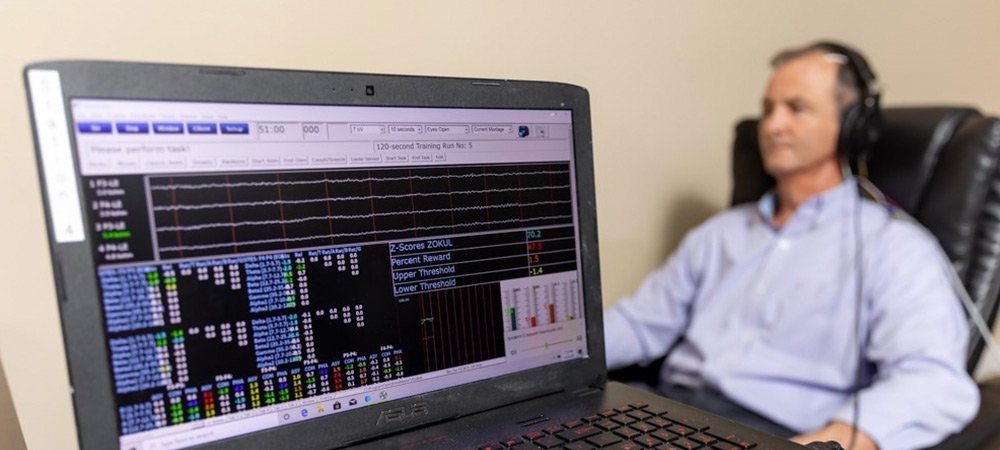
Neurofeedback therapy is one of the most advanced, drug-free treatments available for brain-based conditions including ADHD, anxiety, depression, PTSD, and concussion. At Leigh Brain & Spine in Chapel Hill, North Carolina, our certified neurofeedback specialists use cutting-edge technology to identify and retrain the specific brainwave patterns causing your symptoms — without medication and without side effects.
Backed by over 70 years of research and recognized by the American Academy of Pediatrics, neurofeedback therapy delivers measurable, lasting results. At Leigh Brain & Spine, we’re proud to be a Certified Brain Health Coach Center, offering a leading neurofeedback therapy program in Chapel Hill, NC and the surrounding areas.
What Is Neurofeedback Therapy?
Neurofeedback therapy — also called EEG biofeedback or neurotherapy — is a non-invasive brain training technique that teaches your brain to regulate itself more effectively. The word breaks down simply: neuro (brain) + feedback (real-time input). During a session, sensors placed on your scalp read your brainwave activity and feed that information into a specialized computer system. The system then rewards your brain — through sound and visual cues — whenever it produces healthy, balanced brainwave patterns.
Over time, and with repeated practice, your brain learns to maintain those healthier patterns on its own. The result is a lasting reduction in symptoms — not just temporary relief. Unlike medication that manages symptoms while you take it, neurofeedback therapy addresses the underlying brain pattern at its source.
Neurofeedback Treatment – What To Expect
Step 1: qEEG Brain Map evaluation
Every neurofeedback treatment program at Leigh Brain & Spine begins with a qEEG Brain Map — a comprehensive evaluation that records your brainwave activity in real time. Think of it as a detailed performance map of your brain. Our doctors analyze the map to identify exactly which patterns are causing your symptoms, whether that’s too much slow-wave activity (common in ADHD) or excessive fast-wave activity (common in anxiety). This precision is what separates our individualized approach from generic one-size-fits-all protocols.
Step 2: Personalized neurofeedback sessions
Based on your brain map results, we design a personalized Brain Shift Home Neurofeedback program. In simple words, we create a neurofeedback treatment plan specifically for you. Then using our advanced Online Neurofeedback platform, you will get access to all the training with the specific sessions that are exclusively for your treatment, to help you get your brain stronger and better with every session.
Step 3: Measurable progress tracking and Monthly Check-ins
Every session produces a performance graph showing your brain’s activity. You can see your brain changing, session by session. You don’t need to worry, during the whole process our program will:
- Help you learn how your brain patterns are associated with your symptoms or diagnose.
- Our neurofeedback specialists will take the time to monitor and analyze your results every step of the way and adjust your protocol to keep you on track toward your goals.
Neurofeedback Brain Training – How It Rewires Your Brain
Neurofeedback brain training is founded on one of the most fundamental principles in neuroscience: Hebb’s Law, which states that brain cells that fire together, wire together. Every time a brainwave pattern activates, it gets stronger — for better or worse.
In ADHD, the brain has practiced producing too much slow theta wave activity. In anxiety, it has overused fast beta wave activity. Both patterns get stronger every day they go unchallenged. Neurofeedback brain training interrupts this cycle. By rewarding the production of healthier, more balanced brainwave patterns through hundreds of micro-rewards per session, the brain begins to wire a new, better-performing pattern.
This is neuroplasticity — your brain’s built-in ability to change and grow — put to deliberate use. The more your brain practices the new pattern, the more automatic and stable it becomes. Most patients find that the gains achieved through their neurofeedback program continue to strengthen even after they finish treatment.
This is also why neurofeedback brain training is used by NASA to optimize astronaut focus, by the U.S. military for Special Forces performance and PTSD recovery, and by elite athletes including the U.S. Olympic volleyball team and multiple professional sports organizations. It is not just for people struggling with symptoms — it is a powerful tool for anyone who wants their brain to perform at its best.
Neurofeedback for ADHD
ADHD is fundamentally a brain regulation problem, not a discipline or attention problem. Research consistently shows that brains with ADHD produce an excess of slow theta brainwaves — particularly in the frontal lobe, the area responsible for focus, planning, and impulse control. This excess of slow brain activity creates the hallmark symptoms: difficulty concentrating, easy distraction, impulsivity, and restlessness.
Neurofeedback therapy for ADHD targets this pattern directly. By training the brain to produce less slow-wave activity and more of the focused, alert beta waves associated with calm concentration, patients experience genuine improvements in focus, task completion, emotional regulation, and academic or professional performance — without medication.
At Leigh Brain & Spine, we have treated ADHD in children, teens, and adults using neurofeedback therapy. Each program is guided by a qEEG brain map assessment, ensuring the protocol addresses your specific pattern rather than a generic ADHD template. We work closely with parents, educators, and other providers to ensure the gains achieved in therapy translate into everyday life.

Neurofeedback has been endorsed by the American Academy of Pediatrics as a Level 1 — ‘Best Support’ evidence-based intervention for ADHD, the same rating given to stimulant medications. For families seeking an effective, drug-free ADHD treatment, neurofeedback therapy is one of the most credible options available.
Neurofeedback for Anxiety
Anxiety is what happens when the brain gets stuck in overdrive. When you are anxious, your brain is producing an overabundance of fast high-beta brainwaves — a pattern associated with hypervigilance, rumination, and a chronic sense of threat even when no real danger exists. The harder you try to relax or think your way out of it, the more you reinforce the overactive pattern.
Neurofeedback therapy for anxiety works by teaching your brain to reduce that excessive high-beta activity and increase calmer, more balanced alpha and sensorimotor rhythm (SMR) waves. As the brain practices this calmer pattern during sessions, your nervous system naturally becomes less reactive. Patients typically report improvements in sleep, reduced physical tension, less intrusive worried thinking, and a greater ability to stay present.

Because neurofeedback addresses the neurological root of anxiety rather than managing its symptoms, many patients maintain their improvements long after completing treatment. This stands in contrast to medications that require continued use to sustain their effect.
Neurofeedback therapy for anxiety is particularly effective for generalized anxiety disorder (GAD), social anxiety, panic disorder, and anxiety associated with PTSD or trauma. It can be used as a standalone treatment or alongside therapy and other approaches.
Other Conditions Treated with Neurofeedback
While ADHD and anxiety are the most common reasons people seek neurofeedback therapy, research strongly supports its effectiveness for a wide range of brain-based conditions. At Leigh Brain & Spine, we use neurofeedback as part of individualized treatment programs for:
- PTSD and trauma: neurofeedback has been adopted by the U.S. military as a frontline intervention for combat-related PTSD and traumatic brain injury (TBI)
- Depression: reducing overactive slow-wave patterns in the frontal lobe associated with low mood and low motivation
- Concussion and traumatic brain injury (TBI): supporting the brain’s natural recovery and reducing post-concussion symptoms such as brain fog, headaches, and sleep disruption
- Sensory processing disorders: helping the brain filter and respond to sensory input more appropriately
- Sleep disorders: training the brain to transition more naturally into restful sleep states
- Learning disabilities including dyslexia, dysgraphia, and executive function disorders
- Autism spectrum disorder (ASD): improving social engagement, emotional regulation, and focus
- Tinnitus, chronic pain, and neurological conditions
If you are unsure whether your condition is a candidate for neurofeedback treatment, contact our team or schedule a consultation. We will review your history and help you understand whether a qEEG brain map evaluation is a suitable first step.
Does Neurofeedback Therapy Work? The Science
Yes — and the evidence is substantial. Neurofeedback therapy has been studied and used clinically for over 70 years, with thousands of published research studies documenting its effectiveness across a wide range of conditions.
The American Academy of Pediatrics rates neurofeedback as Level 1 evidence — ‘Best Support’ — for ADHD treatment. The American Psychological Association recognizes it as an empirically supported treatment. Dr. Frank Duffy, MD, Neurologist and Harvard Medical School Professor, has written: in his professional assessment, if any medication demonstrated the same breadth of efficacy seen with EEG biofeedback, it would be universally accepted and in widespread use.
Neurofeedback works through two well-established scientific principles: operant conditioning (the brain learns to repeat patterns that are rewarded and reduce patterns that are not) and neuroplasticity (the brain’s ability to change its structure and function through repeated experience). These are not speculative mechanisms — they are foundational principles of neuroscience.
At Leigh Brain & Spine, we use only the highest-grade clinical equipment available, which allows us to produce objective, measurable data on your brain’s progress throughout your treatment. You will never have to rely on anecdotal reports — you can see your results on a graph.
For a full list of supporting research, visit our Science page
Frequently Asked Questions
What is neurofeedback therapy?
Neurofeedback therapy (also called EEG biofeedback or neurotherapy) is a non-invasive, drug-free brain training technique that uses real-time brainwave monitoring to teach your brain to self-regulate more effectively. Sensors on the scalp read your brainwave activity; a computer rewards healthy patterns with audio and visual feedback. Over time, the brain learns to maintain those healthier patterns independently, reducing symptoms of conditions like ADHD, anxiety, PTSD, and depression.
Does neurofeedback therapy work?
Yes. Neurofeedback therapy is backed by over 70 years of research and thousands of peer-reviewed studies. It is endorsed by the American Academy of Pediatrics as Level 1 evidence for ADHD — the same evidence level as stimulant medications. Most patients complete a full program of 20 to 40 sessions and report significant, lasting improvements in their target symptoms. At Leigh Brain & Spine, results are tracked objectively session by session using clinical-grade equipment.
How does neurofeedback therapy work?
Neurofeedback therapy works through operant conditioning and neuroplasticity. During sessions, your brain receives a reward signal (brighter screen, louder audio) each time it produces a healthier brainwave pattern. The brain naturally seeks to repeat rewarded patterns. Over dozens of sessions, the brain builds and stabilizes a new, healthier operating pattern. This is the same principle by which the brain learns any skill — repeated feedback and practice.
How many neurofeedback sessions will I need?
Most neurofeedback programs involve 20 to 40 sessions, typically completed two to three times per week. The exact number depends on your condition, its severity, and how quickly your brain responds. At Leigh Brain & Spine, your program is tailored to your specific qEEG brain map results and adjusted throughout treatment based on objective progress data.
Is neurofeedback therapy covered by insurance?
Coverage varies by insurer and plan. Some insurance providers cover neurofeedback therapy when it is prescribed for specific conditions such as ADHD, PTSD, or epilepsy. We recommend contacting your insurance provider directly to ask about your specific plan. Our team can provide documentation of treatment to support any insurance submission.
What is the difference between neurofeedback and brain mapping (qEEG)?
A qEEG brain map is the diagnostic evaluation that precedes and guides neurofeedback therapy. It records your brainwave activity across multiple brain regions and identifies the specific patterns causing your symptoms. Neurofeedback therapy is the treatment that uses that map to train your brain toward healthier patterns. Think of the qEEG as the roadmap and neurofeedback as the journey.
Can neurofeedback therapy be done at home?
Yes. Leigh Brain & Spine offers a Professional Home Neurofeedback Therapy rental program. We deliver clinical-grade equipment to your home and provide expert remote guidance from our certified specialists throughout your program. This option is ideal for patients with busy schedules or those outside the immediate Chapel Hill area.
Stop Surviving and Start Thriving with the right Neurofeedback Therapy
Your brain has the ability to change. Neurofeedback therapy gives it the precise, targeted training it needs to build a new, healthier operating pattern — one that supports focus, calm, emotional balance, and quality of life. Thousands of patients have transformed their daily functioning through this science-backed approach. You can too.
Leigh Brain & Spine — Chapel Hill, NC
6110 Falconbridge Road, Suite 100, Chapel Hill, NC 27517.
We will be happy to help with any questions, give us a call: (919) 751-6626
If you have been searching for neurofeedback therapy near me, a neurofeedback clinic in the Triangle, or a brain mapping specialist near me, we serve patients throughout the Triangle area, including Durham, Carrboro, Hillsborough, Pittsboro, Raleigh, Apex, Cary, and surrounding communities.
Fill out the form below for more information.
